

Guide
NCR Property Investment Guide 2026: Honest Returns, Risks & Where to Invest
An honest 2026 guide to investing in Delhi NCR property — how returns really work, the current slower market, which assets and corridors suit which investor, and the risks and discipline that separate a good buy from a bad one.

Sumit Chauhan · Director
Key takeaways
- NCR property is an appreciation-led, 5–10 year play — residential rental yields are modest (~2.5–4%), so most of your return comes from capital growth, not rent.
- In 2026 the market is slower and more selective than the 2020–24 boom, so corridor and project selection matter far more than they did in the rising-tide years.
- Match the asset to your goal: residential for liquidity and end-use, commercial/SCO for higher yield with more risk, plots for long-horizon land appreciation.
- Your two levers are entry price and holding horizon — overpaying late in a cycle or needing a quick exit are the main ways NCR investors lose.
- Buy only RERA-registered projects, verify on the official portal, and treat every 'assured return' or 'guaranteed rent' promise as a risk to scrutinise, not a guarantee.
Property has created more wealth in Delhi NCR than almost any other asset over the last two decades — and it has also trapped more capital in stalled projects, over-priced launches and illiquid plots than almost any other asset. Both things are true, and the difference between the two outcomes is almost never luck. It is discipline: buying the right asset, in the right corridor, at a sensible price, with a realistic horizon, and verifying everything before committing. This pillar guide sets out, honestly, how property returns actually work in NCR, what the 2026 market really looks like, which assets and corridors suit which investor, and the risks that separate a good buy from a bad one. As a RERA-registered channel partner, our interest is in a transaction that works out for you — so this is written to help you invest well, not simply to transact.
How property returns actually work
Every property return is the sum of two components, and confusing them is the root of most bad decisions. The first is rental yield — the annual rent you collect, net of maintenance, vacancy and costs, as a percentage of what you paid. The second is capital appreciation — the increase in the property's value when you eventually sell. Your total return is both, over your holding period.
The single most important fact for an NCR investor is that residential rental yields here are modest — broadly in the 2.5–4% gross range across Gurgaon, Noida and Greater Noida, and lower still after costs. That is far below a fixed deposit, which means residential property in NCR is not an income asset. It is an appreciation asset with a small income offset. Almost all of your return has to come from capital growth, and capital growth is a function of what you buy and, above all, the price you pay for it. Internalise that, and you will avoid the most common NCR investing mistake: buying for "rental income" that never materially arrives, and ignoring the entry price that actually determines the outcome.
The honest 2026 market context
It would be easy, and wrong, to tell you NCR is in a runaway boom. The truth in 2026 is more nuanced and more useful. After a sharp multi-year run from 2020, the market has entered a slower, more selective phase. Knight Frank's H1 2026 research shows residential price growth in the single digits year-on-year across the main NCR markets, alongside a decline in housing sales volumes compared with a year earlier. Prices are still rising in most corridors, but more slowly, and fewer homes are actually changing hands.
For an investor, this consolidation is the most important backdrop to understand, because it changes the rules. In the 2020–2024 rising tide, almost everything appreciated — you could buy carelessly and still profit. In a selective market, the gap between a well-located, well-built, correctly-priced project and a fringe or over-priced one widens sharply: the good asset keeps appreciating while the weak one stagnates or falls. That is why this guide, and our whole approach, keeps returning to project-level fundamentals rather than headline percentages. In 2026, selection is the entire game.
The two levers you actually control
You cannot control the market cycle or interest rates. You can control two things, and they determine most of your outcome.
Entry price. Because returns are appreciation-led, the price you pay is the biggest single determinant of your return. Overpaying late in a cycle, or paying a developer's full "appreciation-loaded" price on a hot launch, eats directly into your gain and destroys your margin of safety if the market pauses. Benchmarking the specific project against genuinely comparable recent transactions — not against the brochure — is the highest-return hour of work you will do.
Holding horizon. NCR rewards patience and punishes impatience. Transaction costs are high (stamp duty, registration, GST on under-construction, and brokerage on resale), yields are thin, and liquidity can be slow, so a short hold rarely covers its costs. A five-to-ten year horizon lets appreciation compound past the frictions and lets you ride out the cycle. If you may need the money in two or three years, NCR property is usually the wrong vehicle.
Get these two right — a sensible entry price and a patient horizon — and you have stacked the odds in your favour before you even choose the asset.
Matching the asset to your goal
NCR offers several investment vehicles, and each behaves differently. The right one depends on your capital, experience and risk appetite.
Residential apartments are the mainstream, lowest-complexity choice — the most liquid, the easiest to finance and rent, and available across every budget. They suit most investors who want a relatively safe, appreciation-led asset with a modest rental offset. The trade-off is exactly that modest yield. Both our How to Buy Property in Gurgaon and Buying Property in Noida and Greater Noida pillar guides walk through the residential buying process on each side of NCR.
Commercial property — offices, retail and especially the shop-cum-office (SCO) format — offers materially higher yields (often 6–10% on well-let units) because commercial rents are higher. But it demands larger tickets, carries leasing and vacancy risk (your yield is only as good as your tenant), and is less liquid. It suits experienced, better-capitalised investors. Our dedicated commercial property and assured-return guide covers this in depth — including the crucial warning on "assured return" schemes below.
Plots and plotted development let you capture land appreciation directly and build to your own design. Historically the highest-returning format on emerging corridors, but a plot earns nothing until built or leased, ties up capital, and can be slow to resell. It suits patient, high-conviction investors, particularly on the Yamuna Expressway near Jewar.
Builder floors offer low-density living with more carpet and often a private terrace, popular in New Gurgaon. They suit end-user-investors but have smaller communities, fewer amenities and resale that depends on the specific colony.
Matching the vehicle to your situation — rather than chasing the highest quoted yield — is the foundation of a sound NCR portfolio.
Where to invest: the NCR corridors at a glance
NCR is not one market but a collection of corridors with different risk-return profiles. On the Gurgaon side, the established Golf Course Road offers prestige and liquidity at mature prices; Golf Course Extension Road offers newer premium stock with strong momentum; the Dwarka Expressway is the large new-build corridor; and New Gurgaon is the value belt. Our best developers in Gurgaon and Golf Course Extension Road guides go deeper on that side.
On the Noida side, established Noida offers connectivity and resale depth, Greater Noida offers planned space and value, Greater Noida West offers affordable high-rise, and the Yamuna Expressway near Jewar is the high-potential, airport-led play. Our Noida and Greater Noida pillar, Noida Expressway Sector 150 and Jewar Airport guides cover these in detail.
The honest point is that no corridor is universally "best." The right corridor depends on your budget, your horizon and whether you prioritise liquidity and prestige (Gurgaon's established belts), value and space (New Gurgaon, Greater Noida), or maximum long-term upside with higher risk (Yamuna Expressway). Match the corridor to your goal, then do the project-level work within it.
The "assured return" warning every NCR investor needs
One pitch deserves a dedicated warning because it has cost NCR investors heavily. Many commercial, SCO and studio products are marketed with an "assured return" or "guaranteed rent" — a promised fixed payout, often 8–12%, for a period before or after possession. Treat these with deep scrutiny. The payout depends entirely on the developer's cash flow, is not protected by RERA, and has in numerous cases simply stopped when the developer ran short of money, leaving investors with an over-priced asset and no promised income. A genuine investment should stand on the strength of the underlying asset — its location, tenant demand and price — not on a promise that is only as good as the promisor's balance sheet. If a deal only works because of the assured return, it usually does not work.
Managing the real risks
Beyond the assured-return trap, disciplined NCR investing means managing a handful of real risks. Developer-delivery risk — mitigated by choosing developers with a genuine delivery record and buying RERA-registered projects on construction-linked payment plans. Liquidity risk — NCR resale can be slow, especially in a consolidating market, so never invest money you may need quickly. Over-supply risk — some corridors carry heavy possession-period supply that softens short-term prices and rents; check how much competing inventory hands over in your window. Legal and tenure risk — Haryana is freehold, UP is largely leasehold with authority dues; understand what you are buying. And leverage risk — do not over-borrow on the assumption that last cycle's gains repeat. Our guide to verifying a RERA project is the single best tool for de-risking any NCR purchase.
The tax and financing realities that shape returns
Two practical factors quietly shape your real return and deserve planning before you buy, not after. The first is tax and transaction cost. Stamp duty and registration (around 7% plus 1% in both Haryana and UP, before any rebate for a woman owner) and 5% GST on under-construction property are real, up-front drags that your appreciation has to overcome before you see a rupee of gain. On exit, capital gains tax applies — lower and indexation-friendly if you hold long enough to qualify as long-term — so the holding period affects your after-tax return as much as the headline price move. Factoring these in is what separates a realistic projection from a brochure one.
The second is financing. Most lenders fund 75–80% of agreement value, and a home loan is a double-edged tool: leverage amplifies your return when prices rise, but it also amplifies your loss and your monthly obligation if they stall. The interest you pay is a genuine cost that eats into net return, though it carries tax benefits that partly offset it. The disciplined approach is to borrow an amount whose EMI, plus maintenance and the loaded one-time costs, sits comfortably within your income — never stretching on the assumption that rapid appreciation will bail out an over-leveraged position. A bank-approved, RERA-registered project also processes faster and carries an extra layer of lender due diligence, which is a quiet form of protection.
How to actually compute your return
Before committing to any NCR investment, model it honestly on paper. Start with the fully loaded entry cost — not the headline price, but with stamp duty (7% in Haryana, 7% in UP, before any rebate), registration, GST if under-construction (5%), preferred-location and floor-rise charges, club and maintenance deposits, and brokerage if resale. Then project your net rental income realistically — actual achievable rent, minus maintenance, minus an honest vacancy assumption, minus taxes — which on residential NCR will be a modest percentage. Then make a conservative appreciation assumption for your corridor and horizon, informed by current data rather than brochure projections. Add the two, subtract your exit costs, and compare the result against a simple alternative such as a fixed deposit or an index fund over the same period. If the property only wins on an aggressive appreciation assumption, you are making a bet, not an investment — which may still be fine, but name it honestly. This disciplined, two-scenario modelling is exactly what we do with clients before they commit.
How Chahat Homes helps you invest
Because we are paid by the developer only on a successful transaction, our investment guidance is free and genuinely neutral across every NCR corridor and asset type. We help you match the asset and corridor to your goal, benchmark the specific project's price against real comparables, verify the RERA registration and the developer's record, model the return honestly in two scenarios, and flag the traps — the assured-return pitch, the over-supplied corridor, the late-cycle price — before you commit. We will also tell you plainly when the honest answer is to wait, to choose a different corridor, or that a non-property investment better fits your goal. Start with the Gurgaon and Noida hubs and the cluster guides linked above, then talk to us to build a shortlist.
The honest bottom line
NCR property can be an excellent long-term investment, but only on terms the marketing rarely states plainly: it is an appreciation-led, five-to-ten-year play with modest yields, in a market that in 2026 is slower and more selective than the recent boom. The investors who do well buy the right asset in the right corridor at a sensible entry price, verify everything, avoid the assured-return trap, and hold. The investors who do badly chase headline percentages, overpay late in a cycle, rely on promised returns, and need to exit too soon. The difference is entirely within your control. Do it with discipline — or let us help you do it with discipline — and NCR property rewards you.
Frequently asked questions
Is property a good investment in NCR in 2026? Yes, for a patient investor with a five-to-ten-year horizon who buys the right asset at a sensible price. But 2026 is a slower, more selective market than the recent boom, with single-digit price growth and softer sales volumes, so corridor and project selection matter far more than they did a few years ago.
What rental yield can I expect from NCR property? Residential gross yields are modest, broadly 2.5–4% across Gurgaon, Noida and Greater Noida, and lower after costs. Commercial and SCO assets can yield more (often 6–10% on well-let units) but carry more risk and less liquidity. NCR residential is an appreciation play, not an income asset.
Which gives better returns — residential or commercial property? Commercial property offers higher rental yields but with greater leasing, vacancy and liquidity risk and larger tickets; residential offers lower yields but better liquidity, easier financing and lower complexity. The right choice depends on your capital, experience and risk appetite, not on the headline yield alone.
Are "assured return" schemes safe? No — treat them as a risk, not a guarantee. Assured-return and guaranteed-rent payouts depend on the developer's cash flow and are not protected by RERA; they have stopped in many real cases. Base your decision on the underlying asset's location, demand and price, never on the promised payout.
How long should I hold an NCR property investment? Generally five to ten years. High transaction costs, modest yields and sometimes-slow liquidity mean short holds rarely cover their costs, while a longer horizon lets appreciation compound past the frictions and ride out the market cycle. If you may need the money within two or three years, property is usually the wrong vehicle.
Which NCR corridor is best for investment? There is no universal best. Gurgaon's established belts offer liquidity and prestige at mature prices; New Gurgaon and Greater Noida offer value; the Yamuna Expressway near Jewar offers high long-term potential with higher risk. Match the corridor to your budget, horizon and risk appetite, then verify the specific project.
How do I protect myself from stalled or fraudulent projects? Buy only RERA-registered projects, verify the registration on the official HARERA or UP-RERA portal, choose developers with a genuine delivery record, use construction-linked payment plans, and get every detail in writing. These steps remove most of the risk that has historically caught NCR investors.
Should I invest in NCR property or financial assets instead? Model both honestly over the same horizon. Property offers tangible, leveraged, appreciation-led returns but with high costs, low liquidity and concentration risk; financial assets offer liquidity and diversification. Neither is universally better — the right answer depends on your goals, and we will tell you honestly when property is not the best fit.

Sumit Chauhan — Director
Mentioned in this article
Related Projects

Gaurs
Gaur Aspire Centurian Park
Greater Noida West, Noida

DASNAC
DASNAC ARC
Sector 72, Noida

Gaurs
Gaur World SmartStreet
Greater Noida West, Noida
Keep reading
Related Insights
Investment Guide
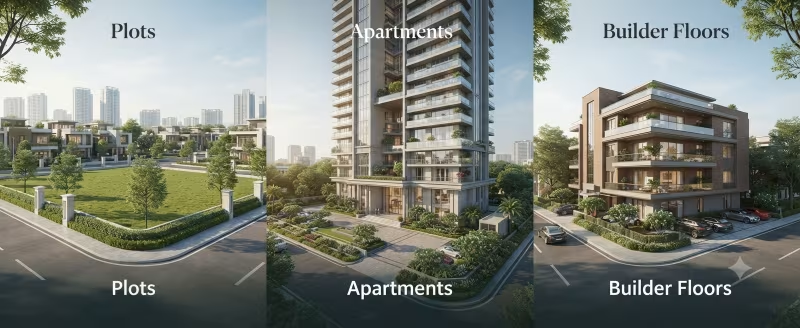
Plots vs Apartments vs Builder Floors in NCR 2026: What Should You Buy?
An honest 2026 guide to choosing between a plot, an apartment and a builder floor in Delhi NCR — the real trade-offs in…

Investment Guide
Ready-to-Move vs Under-Construction in NCR 2026: The Honest Trade-off
An honest 2026 guide to choosing between ready-to-move and under-construction property in Delhi NCR — the real price, GS…

Investment Guide
Best Sectors for Rental Yield in NCR 2026: An Honest Investor's Guide
An honest 2026 guide to rental yields across Delhi NCR — what yields are realistic, which sectors and asset types yield…