DLF
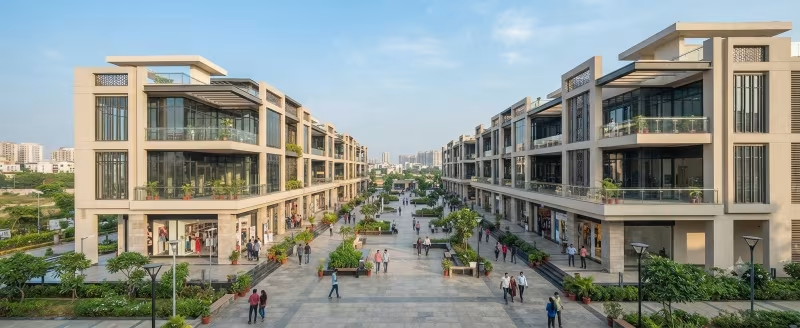
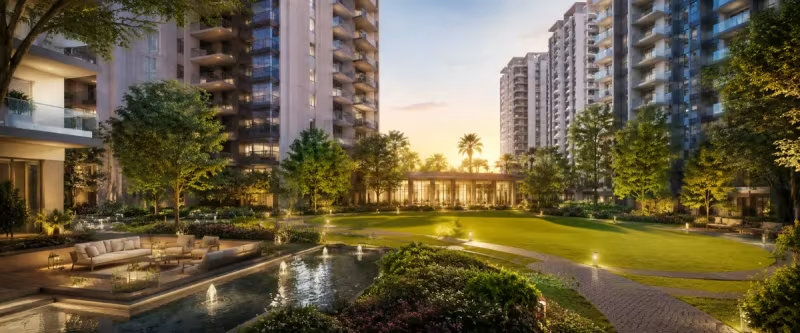
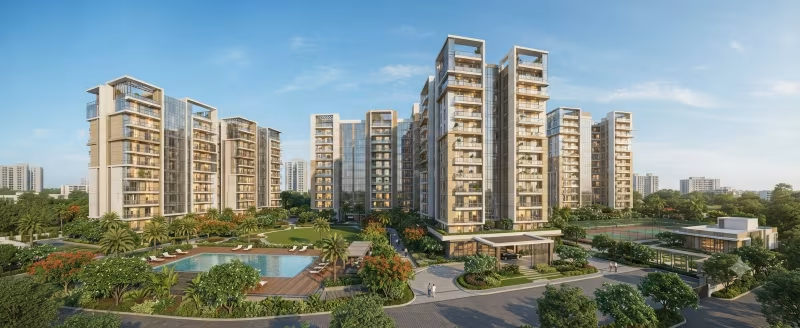
DLF The Grove Dwarka
Dwarka, Delhi

City Guide · Delhi
Delhi is a land-constrained, resale-driven market where the citywide average of 18,500 per sq.ft. is the highest in NCR and new group-housing supply is almost non-existent. Dwarka and the DDA land-pooling zones are the only meaningful sources of new inventory.
Prices updated 27 Jul 2026
Micro-Markets
Each corridor has its own price band, buyer profile and infrastructure story.
Browse by Category
Live Inventory
2 published projects · page 1 of 1
The Market
Delhi behaves unlike either of its satellite cities because it has effectively run out of developable land inside the municipal boundary. The result is a market dominated by resale, redevelopment and builder floors rather than by large gated launches - and one where location premiums are enormous and remarkably stable.
South Delhi is the reference point. Greater Kailash, Defence Colony, Vasant Vihar, Hauz Khas, Safdarjung Enclave and Panchsheel Park trade between 35,000 and 90,000 per sq.ft. on built-up area. The dominant format is the independent builder floor on a 200-500 sq.yd. plot - typically a full floor with two or three parking bays and a lift. Buyers here are almost never investors; they are families upgrading within a two-kilometre radius.
Dwarka in south-west Delhi is the exception to the no-new-supply rule and the reason Delhi appears on a primary-market site at all. Laid out by DDA as a planned sub-city across 56 sectors, Dwarka has cooperative group-housing societies, DDA flats and a growing set of redevelopment projects, priced between 12,000 and 20,000 per sq.ft. It is directly connected to the Blue Line, the Airport Express and now the Dwarka Expressway.
The DDA land-pooling policy covering Zones L, N and P is the one genuine supply story. If executed at scale it would release large tracts in north-west and south-west Delhi for planned development. Progress has been slow and buyers should treat any pre-launch marketed on land-pooling land with extreme caution until sector-level plans are notified.
Central and Lutyens Delhi form a separate market entirely - largely government-owned, with a handful of privately held bungalows trading at valuations that are not comparable to anything else in the country. It is mentioned here only to explain why citywide averages are distorted upward.

Prices & Trends
The citywide average of 18,500 per sq.ft. is the highest in NCR, but the 6.8% year-on-year appreciation is the lowest of the three cities. That combination is exactly what you would expect from a mature, supply-constrained market: high absolute values, modest growth, very low volatility.
Rental yields at 2.8% are the weakest of the three cities. A 5 crore rupee builder floor in Greater Kailash rents for 1.2-1.6 lakh a month. Yields are better - around 3.2% - in Dwarka and in the Rohini and Pitampura belt, where capital values are lower.
Transaction volumes in Delhi are heavily seasonal and heavily driven by circle-rate changes. The city has not revised circle rates since 2014 in most categories, which means the gap between circle and market rate is large in premium colonies and effectively zero in some outer areas - the opposite of the Haryana position.
The practical consequence for buyers: in premium South Delhi colonies, bank valuations frequently come in below the agreed price, so plan for a larger equity contribution than a Gurgaon or Noida purchase of the same value would require.
Getting Around
Delhi Metro is the densest rapid transit network in India at roughly 390 km across ten lines, and metro proximity is a measurable price factor in every part of the city outside the bungalow zone.
The Airport Express Line connects New Delhi railway station to IGI Terminal 3 and Dwarka Sector 21 in about 20 minutes. The Blue Line runs through Dwarka to Noida, and the Magenta Line links South Delhi to Noida directly.
Road connectivity is defined by the Ring Road and Outer Ring Road, the Barapullah elevated corridor connecting South Delhi to east Delhi, and the Delhi-Meerut Expressway. The Dwarka Expressway now links Dwarka directly into Gurgaon Sectors 99-113 and onward to NH-48.
For most South Delhi addresses, IGI Airport is 20-35 minutes. From Dwarka it is 15-20 minutes. That airport proximity is one of the few advantages Delhi retains over the Gurgaon luxury corridor.
What's Coming
Metro Phase 4 is the largest current programme - three priority corridors covering roughly 65 km, including Janakpuri West to RK Ashram, Aerocity to Tughlakabad and Maujpur to Majlis Park. The Aerocity-Tughlakabad line in particular will connect south-west Delhi to the Saket and Tughlakabad belt.
The Delhi land-pooling policy remains the structural supply lever. Zones L, N and P together cover thousands of hectares. Sector plans have been notified in parts and developer consortia have aggregated land, but no large residential completion has yet been delivered under the policy.
Redevelopment of DDA colonies under the in-situ slum rehabilitation and the Kathputli-style models continues in pockets, alongside the far larger central-vista adjacent government housing redevelopment which adds no private stock.
The Yamuna floodplain restoration and the associated construction restrictions matter for east Delhi buyers. Check the NGT zone classification of any east or north-east Delhi property before purchase - it affects both approvals and resale.
Local Guide
Delhi schooling is the deepest in the country: Modern School Barakhamba, Sanskriti, Vasant Valley, DPS RK Puram and Mathura Road, Springdales, Bluebells and The British School are all inside the city. School admission catchment rules make proximity a genuine purchase factor rather than a convenience.
Healthcare is anchored by AIIMS, Sir Ganga Ram, Apollo Sarita Vihar, Max Saket, Fortis Vasant Kunj and BLK Rajinder Nagar. No other NCR city comes close on tertiary care depth.
Retail runs from Khan Market, Connaught Place, South Extension and Hauz Khas Village to Select Citywalk in Saket, DLF Promenade and Emporio in Vasant Kunj, and Vegas and Pacific in Dwarka.
Two practical notes for buyers. First, in unauthorised-regularised colonies confirm the property is on a regularised list and that the sale is by registered conveyance rather than by general power of attorney - GPA transactions are not valid title. Second, Delhi charges 6% stamp duty for men and 4% for women, plus 1% registration, which is materially cheaper than Haryana or Uttar Pradesh.
Who Builds Here
Good to know
Delhi has effectively exhausted developable land inside the municipal boundary. New group-housing supply is limited to Dwarka, DDA schemes and the slow-moving land-pooling zones L, N and P. Almost all Delhi transactions are resale, builder floors on existing plots, or redevelopment.
The citywide average is around 18,500 per sq.ft., the highest in NCR. South Delhi colonies like Greater Kailash and Vasant Vihar trade at 35,000-90,000 per sq.ft. on built-up area, Dwarka sits at 12,000-20,000, and outer belts like Rohini and Uttam Nagar range from 7,000-12,000.
Dwarka is the most practical entry point into Delhi for a primary-market buyer. It is a planned DDA sub-city with Blue Line and Airport Express metro connectivity, direct access to the Dwarka Expressway and IGI Airport within 20 minutes. Pricing at 12,000-20,000 per sq.ft. is well below South Delhi with comparable civic infrastructure.
Six per cent for male buyers, 4% for female buyers and 5% for joint male-female ownership, plus 1% registration charge, calculated on the circle rate or transaction value whichever is higher. That is meaningfully lower than the 7% charged in Haryana and Uttar Pradesh.
A general power of attorney transaction transfers possession without transferring title. The Supreme Court has held that GPA sales do not convey ownership. Insist on a registered sale deed. This matters most in Delhi unauthorised-regularised colonies where GPA transactions were historically common.
About 2.8% on average, the lowest of the three cities covered here. A 5 crore rupee builder floor in a premium South Delhi colony typically rents for 1.2-1.6 lakh a month. Yields improve to around 3.2% in Dwarka, Rohini and Pitampura where capital values are lower.
Not yet, for a residential buyer. Zones L, N and P could release substantial land, but no large residential project has been delivered under the policy and sector-level planning is incomplete. Treat any pre-launch marketed on land-pooling land as a speculative land bet, not a housing purchase.
Delhi wins on schools, tertiary healthcare, airport proximity from the south-west and cultural depth. It loses on new supply, apartment specification, parking and gated-community amenities. Buyers who want a large, well-specified apartment with a clubhouse almost always end up in Gurgaon or Noida; buyers who want an address and land ownership stay in Delhi.
Research First
What Haryana actually charges, how the circle rate interacts with the transaction value, what a home loan will and will…
Yield by micro-market across all three cities, why luxury underperforms on income, and the three factors that actually d…
The two-property rule, the one-million-dollar NRO limit, Forms 15CA and 15CB, section 195 withholding and why the fundin…
We track every launch, every price revision and every infrastructure milestone in Delhi. One call saves weeks of research.
Speak to an advisor
Zero brokerage on primary bookings · RERA-registered · Mon–Sun, 9:30am – 8:00pm IST