

Guide
Builder-Buyer Agreement in NCR 2026: The Clauses That Actually Matter
An NCR channel partner's honest, clause-by-clause guide to the builder-buyer agreement: possession, carpet area, payment plan, forfeiture, force majeure and dispute clauses — what to check and negotiate before you sign in Gurugram, Noida or Greater Noida.

Sumit Chauhan · Director

Signing a builder-buyer agreement is the single most important thing you will do in your entire home purchase — and it is the moment most buyers rush through. By the time the developer's relationship manager slides the document across the table, you have usually already paid the booking amount, you are emotionally committed to the flat, and there is a quiet pressure to "just sign so we can lock the price." That is exactly the wrong frame of mind to be in.
We say this as a RERA-registered channel partner that works across Gurugram, Noida and Greater Noida. We earn our fee from the developer when a sale closes, not from how fast you sign. So this guide is not here to talk you out of buying — it is here to make sure that when you do sign, you understand what you are agreeing to, which clauses are negotiable, and where the law already protects you even if the paper does not say so.
This is general information for NCR home buyers, not legal advice. For a specific agreement on a specific project, have a property lawyer read the full document before you sign. A lawyer's fee is a rounding error against the price of a flat.
What the "builder-buyer agreement" actually is
People use three terms loosely, and the confusion costs buyers money. There is the booking or allotment letter, the agreement for sale, and the final conveyance deed (sale deed). They are not the same document and they do not carry the same weight.
The allotment letter is what you get first, right after you pay the booking amount. It confirms the unit, the tentative price and a broad payment plan. It is not the detailed contract. The agreement for sale — what most people in NCR call the builder-buyer agreement or BBA — is the real contract. Under the Real Estate (Regulation and Development) Act, 2016, this is the document that must be executed and registered before the developer can take a large part of your money, and it is the document that binds both sides on possession date, specifications, carpet area and penalties. The sale deed comes right at the end, at possession, when ownership actually transfers to you.
The single most useful habit you can build is this: treat the allotment letter as a promise and the agreement for sale as the contract. Never let a developer's staff tell you "the booking letter is enough, the agreement is just a formality." It is the opposite — the agreement is where the formality lives.
The legal baseline: what RERA already gives you
Before we get into individual clauses, understand what you are owed by law, because it changes how you read the paper in front of you.
The 10% rule. Under Section 13 of the RERA Act, a promoter cannot accept more than 10% of the cost of the apartment as an advance or application fee before signing a written agreement for sale — and that agreement has to be registered. In plain terms: if a developer is asking for 15%, 20% or 25% "to confirm the unit" before giving you a registered agreement, they are on the wrong side of the law, and you are within your rights to push back.
The agreement must be registered. A registered agreement for sale is not optional paperwork. Registration is what makes the contract enforceable and puts it on the public record. An unregistered "agreement" leaves you far weaker if a dispute ever reaches the authority.
Delay protection. Under Section 18, if the developer fails to hand over possession by the agreed date, you are entitled either to a refund of your money with interest, or — if you choose to stay — to interest for every month of delay until you get possession. This is a statutory right. It exists even if the agreement tries to water it down.
One-sided clauses are not automatically valid. This is the part developers rarely volunteer. Indian courts, including the Supreme Court, have repeatedly held that heavily one-sided terms in a builder-buyer agreement can amount to an unfair trade practice and may not be enforceable against the buyer. So a clause being printed in the agreement does not mean it will hold up if challenged before a consumer forum or the RERA authority. That does not make the clause harmless — fighting it costs time and money — but it does mean you are not as powerless as the document's tone suggests.
Hold these four facts in your head as you read every clause below.
Clause 1: Possession date and the delay penalty
This is the clause that generates the most litigation in NCR, so read it slowest.
First, look for a firm date, not a vague window. "Possession within 48 months from the date of this agreement, plus a grace period of 6 months" is a real commitment you can hold the builder to. "Possession is tentative and subject to approvals" with no outer date is a red flag — it means the clock never really starts.
Second, check the delay compensation. A fair agreement specifies what the developer pays you per month if they miss the date — usually expressed as a rupee figure per square foot per month, or an interest rate on the amount you have paid. Now check the other side of the same page: what interest do you pay if you are late on an instalment? In most standard NCR agreements these two numbers are wildly asymmetric — the developer might owe you a token amount for a two-year delay, while you owe a steep interest rate for a two-week delay. That asymmetry is the clearest signal of a one-sided agreement, and it is the first thing worth raising with the developer before you sign.
Remember the statutory backstop here: even if the agreed per-month penalty is tiny, your Section 18 right to interest on delayed possession still exists. Several NCR buyers have recovered far more through the RERA authority than their agreement's penalty clause offered.
Clause 2: Carpet area, super area and the area-change clause
Two 3 BHKs in the same city can differ by 500–600 square feet on paper while feeling identical inside, because developers sell on super area (your flat plus a share of common spaces, lobbies, walls and sometimes amenities) while RERA defines and protects carpet area — the actual usable floor space within your walls.
Your agreement should state the RERA carpet area clearly, and that figure should match what the developer has declared to the authority on the official portal. Cross-check it. If the agreement says one number and the portal says another, stop and get it reconciled in writing before signing.
Then find the area-variation clause. Almost every agreement allows the final built area to differ from the booked area within some tolerance. The fair version works both ways: if the area shrinks, you get a refund at the same rate you paid; if it grows beyond a small band, you should have the right to walk away rather than be forced to pay for space you never wanted. Watch for versions that let the developer increase the area and bill you, but give you nothing back if it decreases. That is negotiable, and worth negotiating.
Clause 3: Payment plan, price and hidden charges
The agreement will specify a payment plan — typically a construction-linked plan (CLP), where instalments fall due as the building hits milestones, or a subvention / "no EMI till possession" structure. Make sure the plan written in the agreement is the one you were verbally promised, because the two often drift apart between booking and signing.
The price should be itemised and stage-linked, not a single lump sum with "plus applicable charges" tacked on. Here is where NCR buyers routinely get surprised, so look specifically for:
- EDC and IDC (external and internal development charges) — large, legitimate, but sometimes quoted as "extra" after you thought the price was final.
- PLC (preferential location charges) for a park-facing, corner or higher-floor unit.
- IFMS (interest-free maintenance security), club membership and parking charges.
- GST, and who bears future tax changes.
- Any escalation clause that lets the developer raise the base price after you have signed. A fair agreement fixes the base price; an open-ended "cost escalation at developer's discretion" clause is one you should resist.
Add all of these up before you decide the flat is affordable. The gap between the "starting price" in the brochure and the all-in cost in the agreement is often 15–25%.
Clause 4: Cancellation, forfeiture and refund
Life changes, and sometimes buyers need to exit before possession. The agreement will say what happens to your money if you cancel. Typically the developer reserves the right to forfeit the earnest money — often around 10% of the unit cost — plus any brokerage, taxes already paid and interest due.
Read this clause carefully for two things. First, how much is actually at risk — is "earnest money" clearly defined, or is it left vague enough to swallow most of what you have paid? Second, check whether the forfeiture is reciprocal: if the developer cancels or fails to deliver, do you get a clean refund with interest, or do they get to keep deductions even when the fault is theirs?
As noted earlier, blanket forfeiture of large sums — especially when the buyer is exiting for a legitimate reason or the developer has defaulted — has been challenged successfully before RERA tribunals and consumer forums as a one-sided term. Know that the printed clause is not always the final word.
Clause 5: The transfer or assignment fee
If there is any chance you will resell the unit before possession — common for investors, and more common than buyers expect for end-users whose plans change — find the transfer (assignment) clause. Developers charge a fee, usually per square foot, to endorse a transfer to a new buyer. On a large unit this can run into several lakhs.
A high transfer fee quietly locks you in: it makes an early exit expensive and hands the developer leverage. You will not usually negotiate this away entirely, but you should know the number before you sign, not discover it the day you try to sell. Also check whether the clause requires the developer's "consent" for a transfer and whether that consent can be withheld arbitrarily — a fair clause allows transfer on payment of the stated fee once your dues are clear, rather than leaving it to the developer's discretion.
Who pays to register the agreement
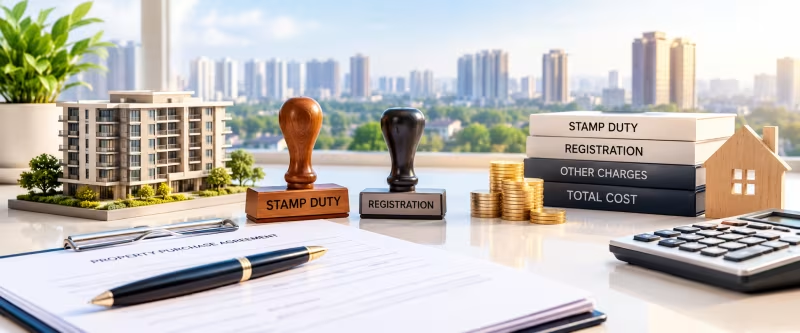
The agreement for sale has to be registered, and registration carries a stamp-duty and registration cost that varies between Haryana and Uttar Pradesh. Your agreement should say clearly who bears this cost — in most standard NCR agreements it falls on the buyer, which is normal, but the point is that it should be stated, not assumed. Factor it into your all-in budget alongside the base price and development charges.
Do not confuse this with the much larger stamp duty payable at the final sale deed, when ownership transfers to you at possession. The two are separate events with separate costs, and buyers who budget for only one of them get a nasty surprise later. Our guide on stamp duty and the true cost of buying property in NCR breaks down both stages and the state-wise rates in detail; read it before you finalise your budget, because the registration and stamp-duty line items together can add a meaningful percentage to the headline price.
Clause 6: Force majeure and specification changes
Every agreement has a force majeure clause excusing the developer from delay caused by events beyond their control — genuine natural disasters, war, a court stay. The problem is how broadly it is drafted. Watch for versions stretched to cover routine things like "delay in government approvals" or "shortage of labour or materials," which are ordinary business risks the developer is supposed to plan for. An over-broad force majeure clause can be used to extend the possession timeline almost at will.
Separately, look for the specification-change clause. Developers often reserve the right to alter the layout, the brand of fittings, common-area plans or even the number of towers. A fair clause limits this to minor, necessary changes; an open-ended one lets the project you were sold quietly become a different project.
Clause 7: Dispute resolution
Finally, check how disputes are meant to be resolved. Some agreements route everything to arbitration on terms set by the developer, or try to confine you to particular courts. Here is the key point: an arbitration or jurisdiction clause in the agreement cannot take away your right to approach the RERA authority or a consumer forum. RERA was created precisely to give buyers a faster, cheaper remedy than civil courts. A clause that appears to shut that door does not actually override the statute, but its presence tells you how the developer thinks about disputes — and that is useful to know going in.
NCR specifics: which regulator is yours?
NCR straddles two states, and that decides where you verify the project and where you complain if things go wrong.
- Gurugram, Faridabad and the rest of Haryana NCR fall under HARERA (the Haryana authority, with the Gurugram bench handling most of the city's projects). Verify the project's registration and declared details on the Haryana RERA portal.
- Noida, Greater Noida, Greater Noida West (Noida Extension), Ghaziabad and the Yamuna Expressway fall under UP-RERA. Verify on the Uttar Pradesh RERA portal.
Before you sign anything, pull up the project's registration page on the correct portal and match three things against your agreement: the RERA registration number, the registered possession date, and the carpet area. If the paper and the portal disagree, that disagreement is your conversation to have before signing, not after. Our separate guide on how to verify a RERA-registered project walks through this step by step.

Your pre-signing checklist
Before you put pen to the agreement for sale, confirm you can answer yes to each of these:
- The project's RERA number on the agreement matches the state portal (HARERA for Gurugram, UP-RERA for Noida/Greater Noida).
- The agreement is being registered, not just signed and handed back as a photocopy.
- The developer is not demanding more than 10% before the registered agreement.
- There is a firm possession date with a defined grace period and a stated delay penalty.
- The carpet area is stated and matches the portal; the area-change clause protects you both ways.
- The price is itemised — base, EDC/IDC, PLC, IFMS, parking, GST — with no open-ended escalation clause.
- You know the cancellation and forfeiture terms and whether they apply reciprocally to the developer.
- You know the transfer fee if you might resell before possession.
- The force majeure clause is narrow, and the specification-change clause is limited to minor changes.
- A property lawyer has read the full agreement and explained anything you did not understand.
If you cannot tick all ten, you are not ready to sign — you are ready to negotiate.
How we think about this
A good channel partner's job is not to get your signature on a page as fast as possible. It is to make sure the project is real, the registration is clean, and you walk into the agreement knowing what every important clause means. We work with M3M, DLF, Godrej, ATS, Gaur, Prateek and others across NCR, we see these agreements constantly, and we are paid by the developer — which means reviewing the clauses honestly with you costs you nothing and changes nothing about your price.
What we cannot do is replace your lawyer, and we will never pretend to. Use this guide to know what to look for; use a lawyer to confirm it on your specific document; and use the RERA portal to check that the paper and the public record say the same thing. Do those three, and the most important signature of your life stops being a leap of faith and becomes an informed decision.
If you want, send us the project you are considering and we will tell you its RERA status and flag the clauses worth reading twice — before you sign, not after.
Part of a bigger guide
This article is one chapter of our complete guide: The NCR Home-Buying Process 2026: Legal, RERA & Costs Explained.

Sumit Chauhan — Director
Keep reading
Related Insights

Buyer Guide
Home Loan Guide for NCR Home Buyers (2026): Honest, No Sales Pitch
An honest, NCR-specific home loan guide from a channel partner that earns nothing from your loan: how much you can reall…
Legal and RERA
Stamp Duty, Registration & the True Cost of Buying Property in NCR 2026
An honest 2026 breakdown of the true cost of buying property in Delhi NCR — stamp duty and registration in Haryana and U…

Legal and RERA
The NCR Home-Buying Process 2026: Legal, RERA & Costs Explained
An honest, step-by-step 2026 guide to the legal and financial process of buying a home in Delhi NCR — budgeting the true…